
In Kenya’s gaming economy, commercial growth and strong safeguards depend on each other. In a digitally connected sector, institutional weaknesses carry real costs for operators: higher compliance burdens, restricted access to banks and payment rails, weaker consumer trust and reduced investment.

Investing in market integrity is a logical response, because it reduces these risks. Lower risk supports regulatory clarity and financial-sector confidence, and it strengthens the ability of credible companies to invest.
Market integrity can be seen as economic infrastructure because just as the digital payment rails, telecommunications network and databases serve as the foundation of the Kenyan digital economy, responsible gaming, financial accountability and consumer protection framework could facilitate the development of the gaming market.
Responsible growth is an investment in the long-term sustainability of Kenya’s gaming market and it supports the sector’s economic growth.
Executive Summary
According to H2 Gambling Capital, Kenya’s interactive (online) gambling market generated an estimated $677.5 million in gross win in 2025, of which $553.7 million was onshore and 123.8 million offshore. On this measure Kenya ranks among Africa’s largest gambling markets, behind South Africa(3.3 billion), Nigeria (1.1billion) and Ghana(883 million). The industry now spans mobile money networks, commercial banks, payment service providers (PSPs), complex data pipelines and an emerging legislative and regulatory framework.
The question for investors, government and development finance institutions is whether Kenya can build the institutional, financial and consumer protection infrastructure that makes this growth sustainable and credible. This article sets out the business case for the Kenya Gaming Market Integrity & Responsible Growth Initiative, a multi-stakeholder forum that brings these stakeholders together around a programme of practical interventions.
A market that builds trust among consumers, operates under strong institutional and financial controls and gives regulators and investors credible, timely information is easier to invest in and easier to sustain. Better consumer protection, financial integrity and regulatory coordination can support growth and make the sector easier for institutional investors to assess.
In Kenya today, gaming sits inside the country’s digital payment system. The 2024 FinAccess Household Survey found that 82.3% of Kenyan adults use mobile money and 52.6% use it daily, and the Communications Authority of Kenya (CA) reports that smartphones make up about 64% of the mobile devices connected to Kenyan networks. Betting deposits and payouts rely heavily on these channels, so gaming transactions form a significant part of everyday digital micro-payments. Every deposit, every bet, every payment and every settlement is linked to an actual transaction flow.
Table 1: Kenya Gaming Economy Key Indicators & Projections (2022 to 2026E)
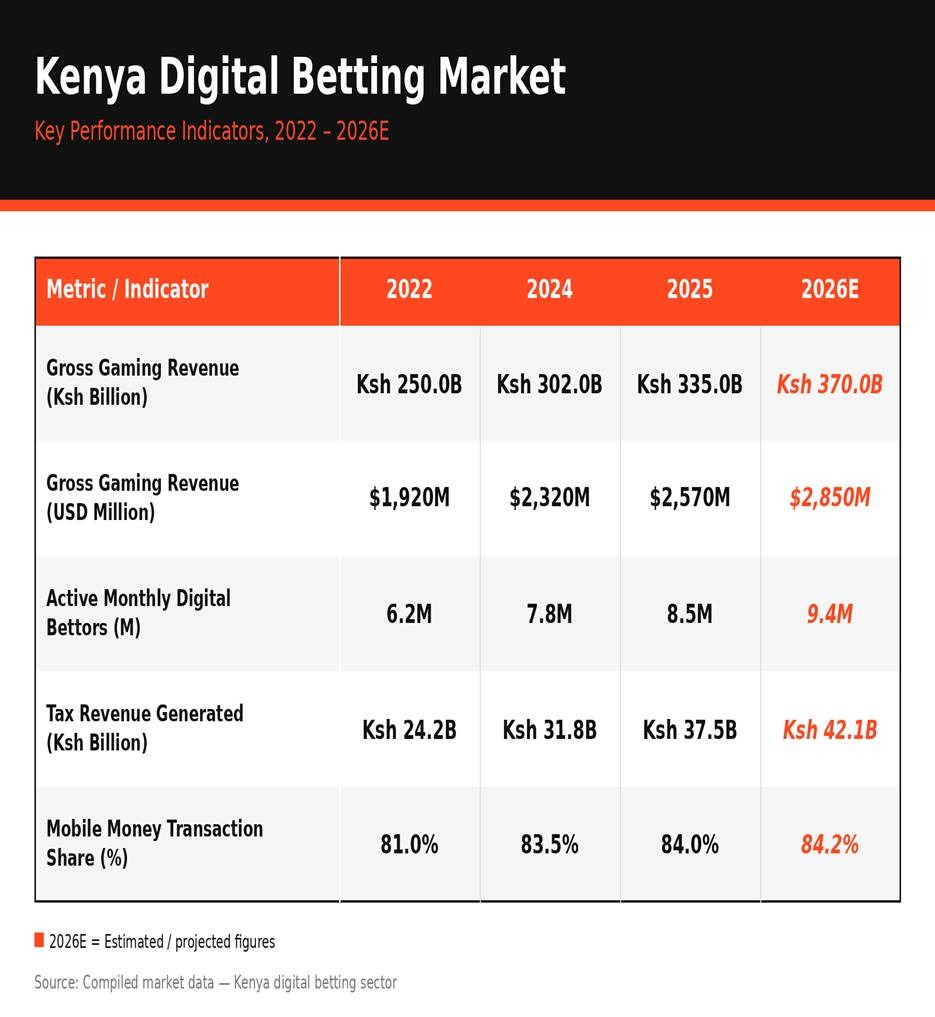
Figures marked E and figures from Credence Africa analysis are estimates. For reference, H2 Gambling Capital puts Kenya’s 2025 interactive gross win at $677.5 million (onshore $553.7 million, offshore $123.8 million).
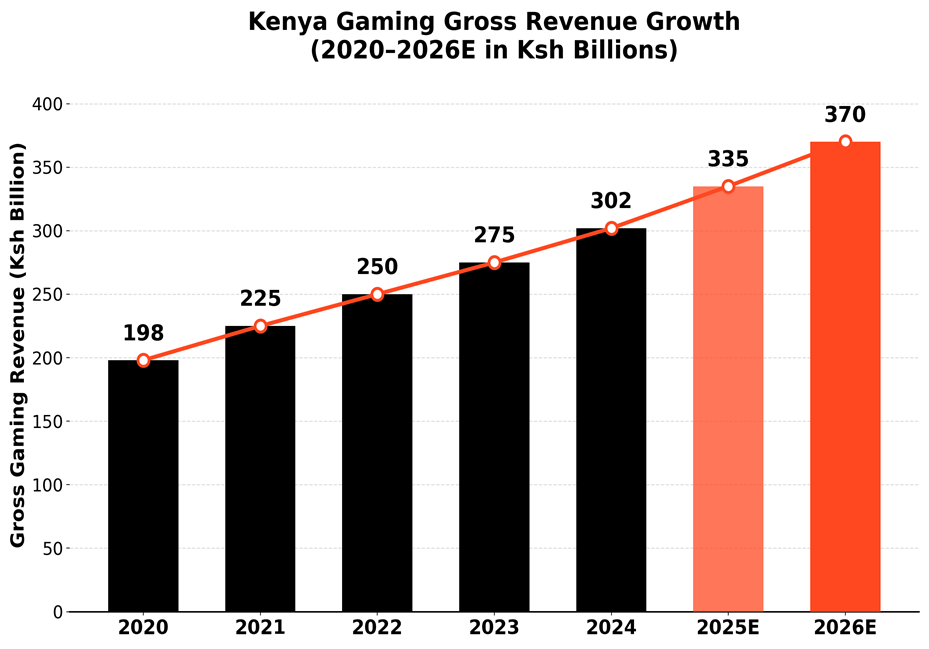
Figure 1: Trajectory of Kenya Gaming Gross Revenue Growth (2020 to 2026E in Ksh Billions). Source: Credence Africa Analytics.
Such extreme integration of the financial nature of this industry changes the risks faced entirely. Each transaction that takes place through an individual's use of the system represents a point of contact between identity verification procedures know your customer (KYC), proper handling of transactions, taxation (excise and withholding taxes), consumer rights and money laundering control. As a result, market integrity cannot be addressed through public relations alone but represents a core systems architecture issue that involves all sectors that includes mobile network operators (MNOs), financial intelligence units, banks and gaming companies.
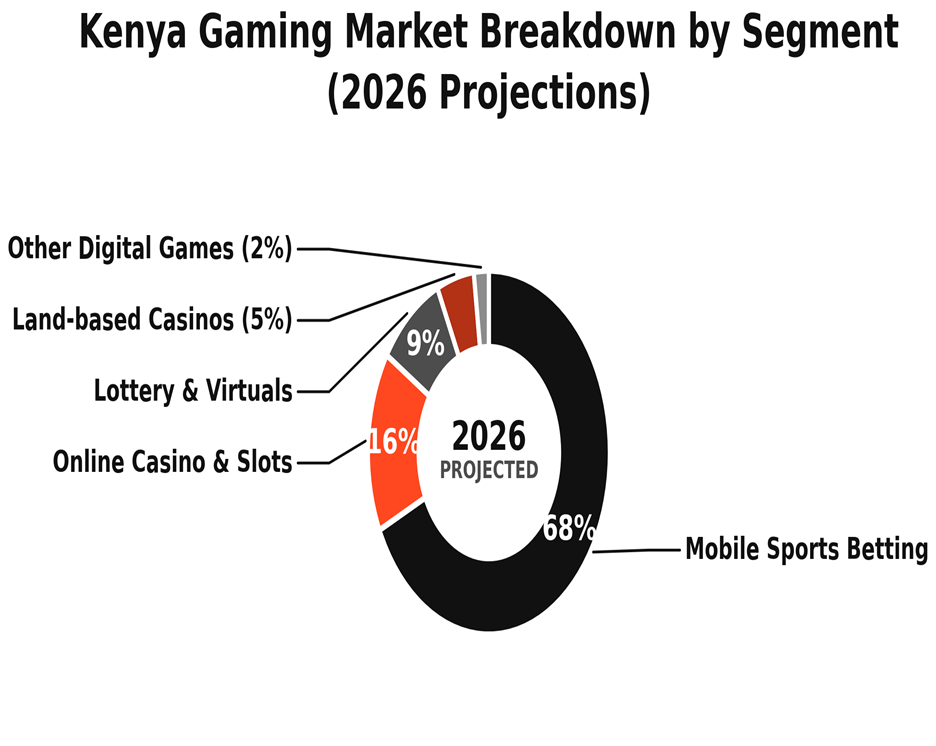
Figure 2: Kenya Gaming Market Share Distribution by Segment (2026 Estimates). Source: Credence Africa Intelligence.
Traditionally, responsible gaming was seen as a voluntary Corporate Social Responsibility (CSR) responsibility or compliance box to tick. In a mature market scenario like 2026, responsible gaming should be re-defined as an important function of market development. The sophisticated model for responsible gaming goes beyond just giving warnings as it is one that establishes a data structure which recognizes behavioral risks, protects vulnerable demographics and offers market intelligence to regulators.
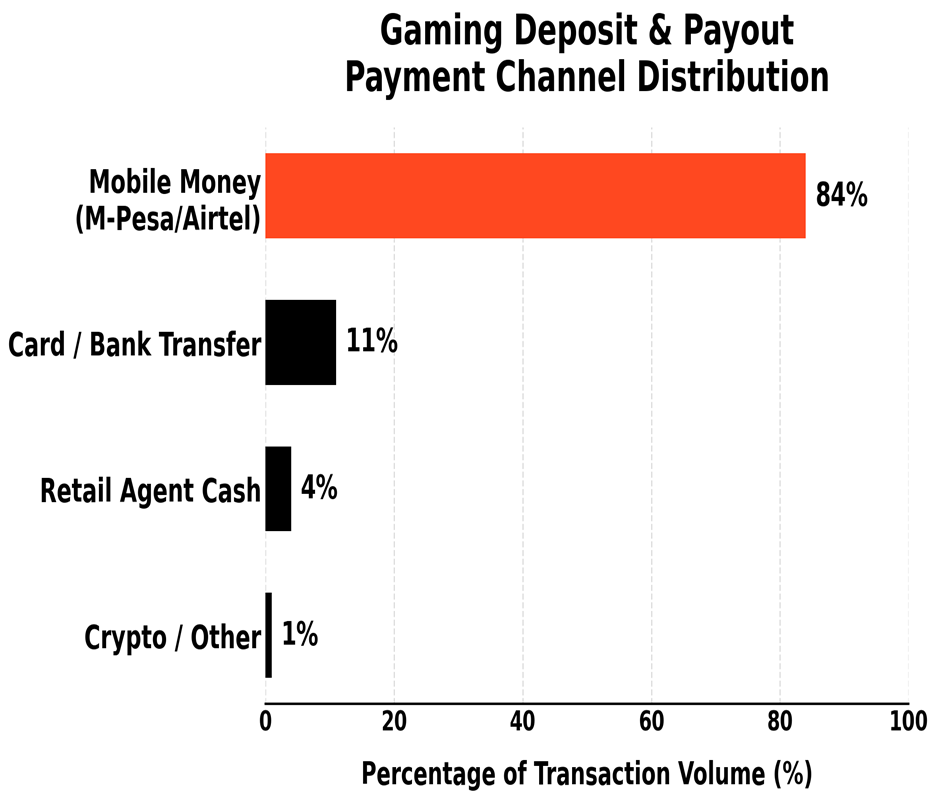
Figure 3: Estimated Payment Channel Distribution for Deposit & Settlement Volumes (2026). Mobile money accounts for an estimated 84% of total flows. Source: Credence Africa estimate.
The aim of this modernization is to separate sustainable, responsible business from business that generates debt burdens, erodes consumer trust and encourages capital flight, and to support legitimate operators in doing so. Institutional investors in fintech and gaming markets across Africa assess the ESG risks and regulatory certainty of each market, and strong integrity frameworks make that assessment easier.
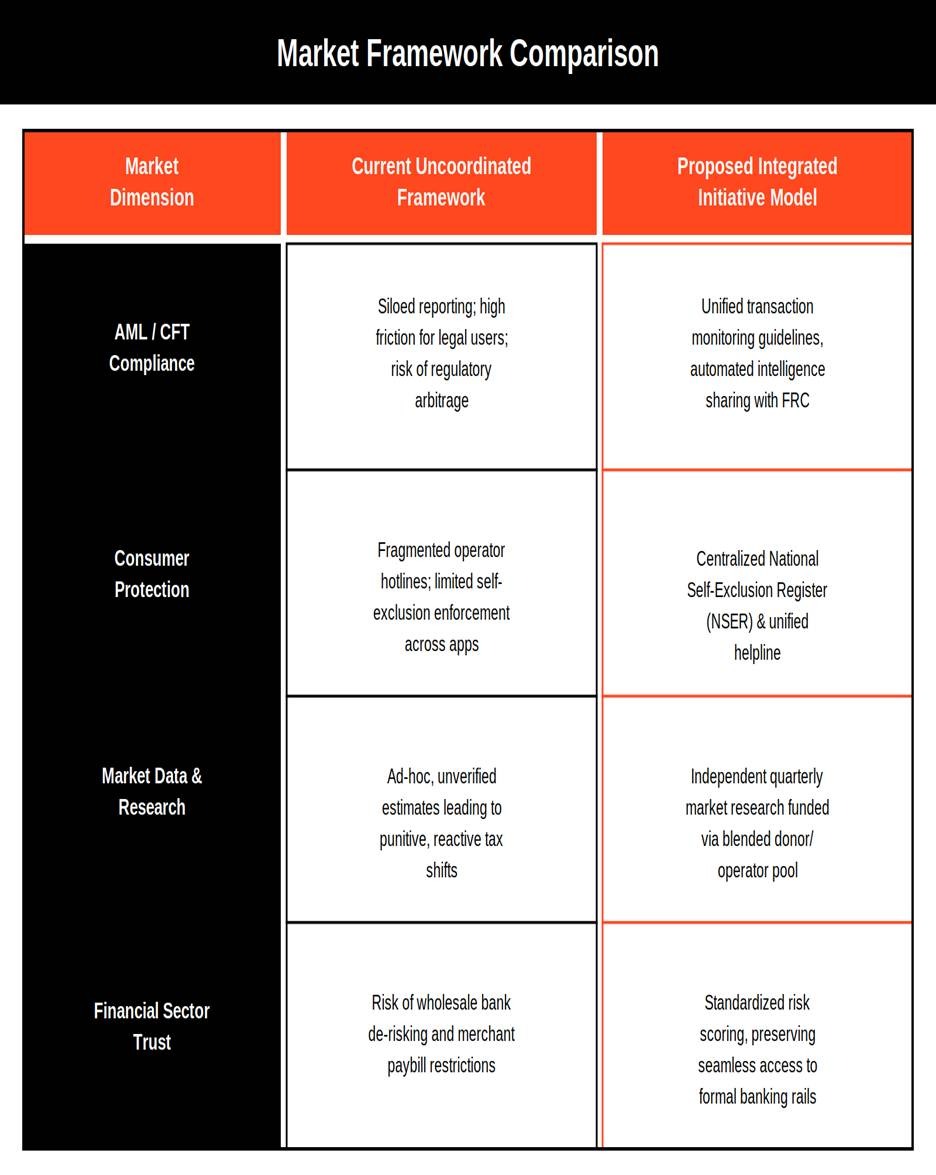
Table 2: Comparative Analysis: Uncoordinated vs. Integrated Market Infrastructure
Anti-Money Laundering and Counter-Financing of Terrorism (AML/CFT) compliance is a stringent legal requirement in Kenya’s gaming industry. Because an estimated 84% of gaming deposits are made through digital wallets such as M-Pesa and Airtel Money (Credence Africa estimate), AML adherence is also central to market trust and stability.
Where commercial banks or financial institutions use a hard de-risking approach as a result of their perceived risk, operators face serious operational difficulties. More alarmingly such de-risking results in casual bettors and fringe operations moving to underground offshore betting which makes transactions less visible to both the Financial Reporting Centre (FRC) and the Kenya Revenue Authority (KRA). The idea behind the project is that there should be a Risk-Based Financial Integration Framework that increases Tier-2/Tier-3 KYC scrutiny, suspicious transactions reporting (STR) and automation of source-of-funds thresholds without affecting payment convenience for legitimate bettors.
What is the Kenya Gaming Market Integrity and Responsible Growth Initiative?
The Kenya Gaming Market Integrity & Responsible Growth Initiative is proposed as an ongoing multi-stakeholder market development forum that strengthens the institutional framework within which Kenya’s gaming sector operates.
The Initiative would work alongside the Gambling Regulatory Authority (GRA), not in place of it. It would hold no licensing, supervisory or enforcement powers and it would not act as an industry association or lobbying body. The GRA already has statutory functions in market monitoring, player-protection research and harm reporting, including a Player Protection and Research Unit and a planned central monitoring system. The Initiative would support these functions through shared data arrangements, independent research and sector-wide coordination, and it would offer standards that the GRA can adopt, adapt or decline.
The fundamental objective of this initiative would be to address risks which are beyond the scope of one single entity to deal with. The Initiative would operate across four functions:
1. Convene
Bring together regulators, financial institutions, operators, technology providers and development partners.
2. Generate Intelligence
Produce independent research, market data and risk analysis.
3. Build Standards
Develop practical frameworks for consumer protection, financial integrity and responsible growth.
4. Mobilize Investment
Create a platform through which shared market infrastructure can attract catalytic and blended financing.
Proposed Governance Architecture
1. Governing Council
Provides strategic oversight and includes representatives from:
a) Government and regulatory institutions
b) Licensed gaming operators
c) Banks and payment service providers
d) Consumer protection institutions
e) Independent experts
f) Development partners
2. Technical Secretariat
Responsible for:
a) Research
b) Programme management
c) Stakeholder coordination
d) Monitoring and evaluation
e) Development of standards
3. Independent Advisory Panel
Provides specialist expertise in:
a) AML/CFT
b) Consumer protection
c) Financial technology
d) Data governance
e) Responsible gaming
4. Funding Partners Forum
Coordinates contributions from:
a) DFIs
b) Foundations
c) Industry participants
d) Technology partners
e) Institutional funders
Integrity safeguards. The GRA would hold a seat on the Governing Council and co-chair it. No stakeholder group, including licensed operators, would hold a majority. Operator contributions would be pooled in a funding firewall, so that funders do not direct research topics or findings. Research methodology and findings would be published, and an independent evaluation would be carried out at the end of Phase I and Phase III. A formal data-sharing arrangement with the GRA would be agreed at the outset.
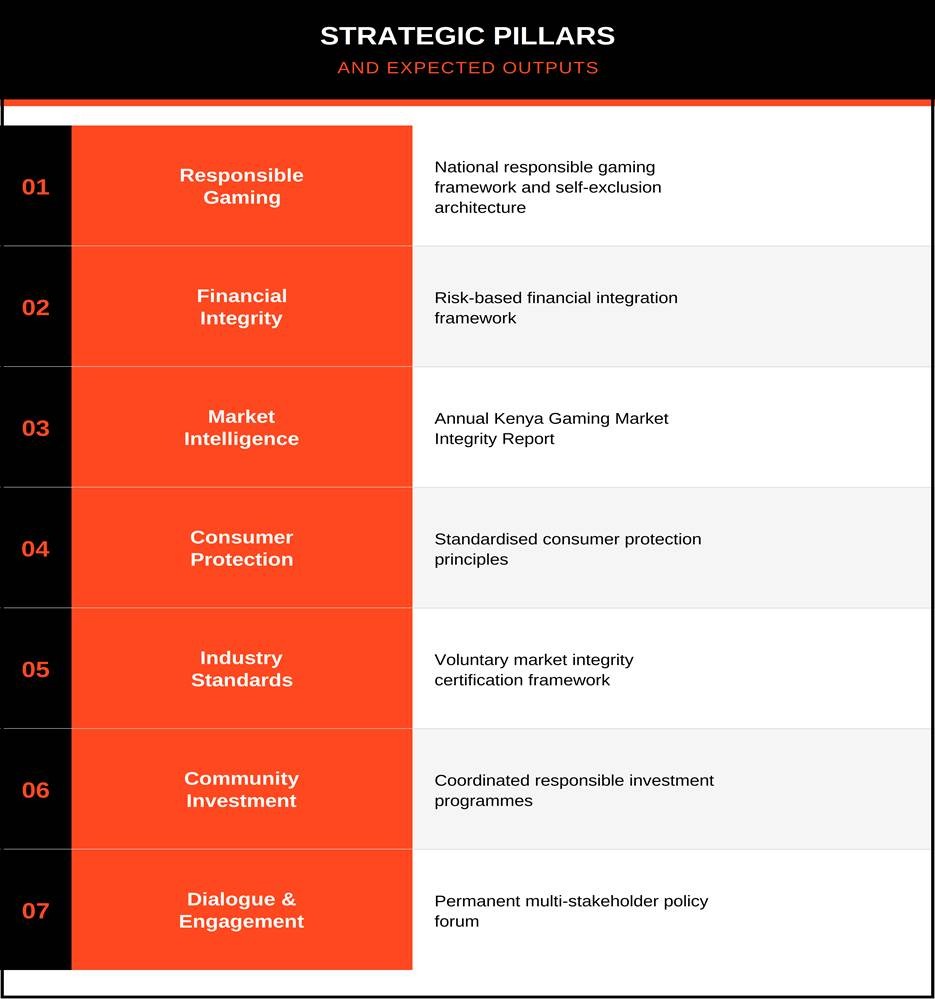
To create a functional ecosystem, the Initiative has been designed using seven interlocking strategies:
Strategy 1: Responsible Gaming & Risk Reduction: Support consumer education, self-exclusion uptake and referral pathways to local help services, alongside the player-protection requirements already set under the Gambling Control Act and its 2026 regulations. Share lessons from operator pilots with the GRA’s Player Protection and Research Unit.
Strategy 2: Financial & Market Integrity (AML/CFT): Support risk assessments of payment chains, joint AML guidance between banks and mobile network operators, and better transaction-monitoring practice, in coordination with the Financial Reporting Centre, the Central Bank of Kenya and the GRA.
Strategy 3: Market Intelligence & Independent Research: Produce independent and academic research on payment flows, youth betting patterns, consumer behaviour and the impact of regulation. This research would be shared with the GRA and designed to complement its monitoring and research functions.
Strategy 4: Consumer Protection & Transparency Guidance: Develop practical guidance on odds disclosure, bonus terms, dispute resolution and payout timelines, offered to the GRA as input to its own standards.
Strategy 5: Voluntary Standards & Benchmarking: Develop voluntary good-practice benchmarks for governance, data privacy and integrity, offered to the GRA for adoption or alignment. Any public recognition would be a benchmark and would not replace or resemble a license.
Strategy 6 (separate track): Community Investment: Support youth financial education, sports facilities and digital training through development-partner and foundation funding only, not operator gambling revenue, with its own governance and reporting.
Strategy 7: Dialogue & Engagement: Open evidence-based channels of engagement between operators and the Gambling Regulatory Authority (GRA) and the Central Bank of Kenya.
The facility will not be used for funding gaming activities. The facility will be used to fund market infrastructure development which will not have much incentive or capability on its own. The proposed $12.5 million facility will be used to fund the three-year program aimed at developing the systems, research capabilities, standards and institutions needed for increasing the integrity of the market.
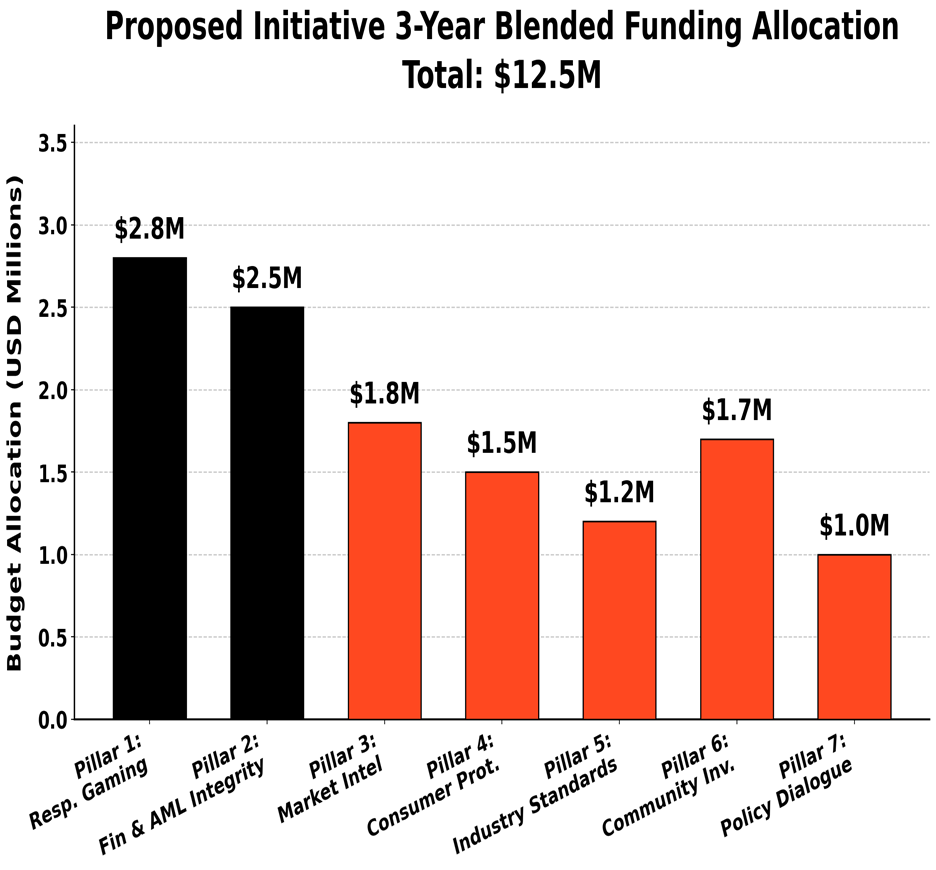
Figure 4: Proposed $12.5 Million 3-Year Blended Funding Model Allocation across Pillars. Source: Initiative Design Blueprint.
Shared infrastructure necessitates a cooperative approach that includes financing streams other than just relying on government funding or individual vanity projects by one organization. The proposed 3-Year Budget ($12.5M total) is set up as a catalytic facility:
Table 3: Multi-Stakeholder Blended Funding Architecture (2026 to 2028)
Timing and market context. The Initiative would launch during a period of regulatory transition. The Gambling Control (Licensing) Regulations, 2026, gazette on 29 June 2026, set a Ksh50 million licence fee and a KSh5 million application fee for online bookmakers. The fee provisions are the subject of a High Court challenge that was still pending at the time of writing. Separately, challenges to the appointment of the GRA’s Director General are before the courts. Operators absorbing higher licensing costs may be cautious about new funding commitments, so the Funding Partners Forum combines DFIs, foundations, technology partners and industry and the facility does not depend on operator contributions alone.
What Successful Investment Would Deliver
The Initiative needs to evaluate success in five different domains:
1. Financial System Trust
- Increased access to banks for operators in compliance
- Greater visibility of risks in the payments space
- Less dependence on universal de-risking
2. Market Transparency
- Greater availability of market data
- Improved transaction visibility
- Enhanced regulatory intelligence
3. Consumer Protection
- Increased use of self-exclusion measures
- Faster resolution of disputes
- Enhanced transparency requirements
4. Regulatory Coordination
- Enhanced information sharing mechanisms
- Less duplication of effort across institutions
- Evidence for regulatory reform
5. Investment Readiness
- Enhanced regulatory predictability
- Greater investor confidence
- Enhanced capability to attract investment
Implementation Roadmap
Phase I: Laying the Groundwork
- Develop governance framework
- Identify stakeholders
- Perform baseline market integrity analysis
- Develop responsible gaming frameworks
- Begin financial sector discussion
Phase II: Implementing the Systems
- Pilot responsible gaming system
- Develop industry standards
- Enhance financial integrity frameworks
- Implement market intelligence reporting
- Develop certification frameworks
Phase III: Scaling Up and Institutionalizing
- Scale-up implemented systems
- Assess market performance
- Develop regional partnerships
- Access long-term financing
- Make Kenya a regional market integrity leader
The next phase of growth of Kenya's gaming industry will depend on a combination of trust and technology. Consumers' trust in the integrity and fairness of the platforms, commercial banks and payment gateway companies' trust in the transparency of flows and the monitoring thereof, regulators' trust in the systemic integrity of operators and institutional investors' trust that the Kenyan market is a safe and reliable place to invest money over a prolonged period of time.
The Kenya Gaming Market Integrity and Responsible Growth Initiative offers exactly this connective tissue for linking commercial operators, government agencies, development partners, and financial institutions. By building this system of trust early, Kenya can position itself as a well-regulated and sustainable gaming market in Africa.
Samuel Kirobi